‖n. (Bot.) A kind of persimmon tree (Diospyros discolor) from the Philippine Islands, now introduced into the East and West Indies. It bears an edible fruit as large as a quince. [ 1913 Webster ]
n. A total prohibition of intercourse with, use of, or approach to, a given person or thing under pain of death, -- an interdict of religious origin and authority, formerly common in the islands of Polynesia; interdiction. [ Written also tabu. ] [ 1913 Webster ]
v. t. [ imp. & p. p. Tabooed p. pr. & vb. n. Tabooing. ] To put under taboo; to forbid, or to forbid the use of; to interdict approach to, or use of; as, to taboo the ground set apart as a sanctuary for criminals. [ Written also tabu. ] [ 1913 Webster ]
a. [ Written also tabu and tapu. ] [ Polynesian tabu, tapu, sacred, under restriction, a prohibition. ] Set apart or sacred by religious custom among certain races of Polynesia, New Zealand, etc., and forbidden to certain persons or uses; hence, prohibited under severe penalties; interdicted; as, food, places, words, customs, etc., may be taboo. [ Webster 1913 Suppl. ]
(n) a prejudice (especially in Polynesia and other South Pacific islands) that prohibits the use or mention of something because of its sacred nature, Syn.tabu
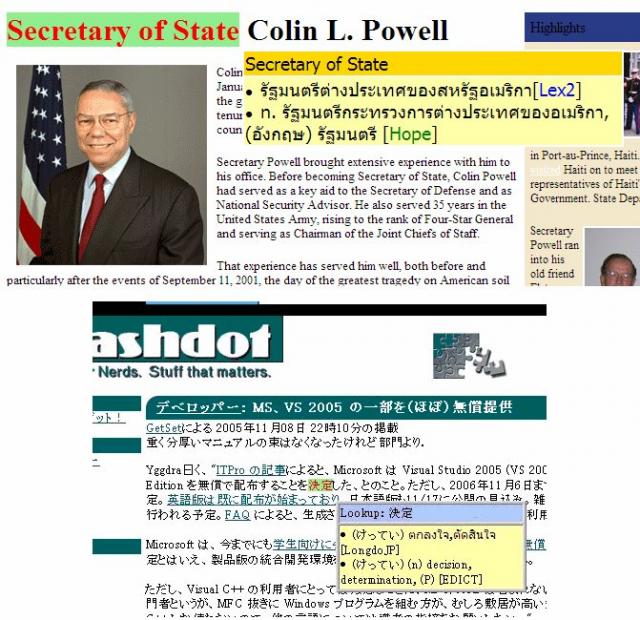
แสดงได้ทั้งความหมายของคำเดี่ยว และคำผสม ได้อย่างถูกต้อง
เช่น Secretary of State=รัฐมนตรีต่างประเทศของสหรัฐฯ (ในภาพตัวอย่าง),
High school=โรงเรียนมัธยมปลาย