(adj) not embarrassed; - Jerome Stone, Syn.unembarrassed, Example: a tinseled charm and unabashed sentimentality; an unembarrassed greeting as if nothing untoward had happened
(adj) (usually followed by `to') not having the necessary means or skill or know-how, Ant.able, Example: unable to get to town without a car; unable to obtain funds
(adj) (usually followed by `to') lacking necessary physical or mental ability, Example: dyslexics are unable to learn to read adequately; the sun was unable to melt enough snow
(adj) (used of vowels or syllables) pronounced with little or no stress, Syn.light, weak, Example: a syllable that ends in a short vowel is a light syllable; a weak stress on the second syllable
a. Not able; not having sufficient strength, means, knowledge, skill, or the like; impotent; weak; helpless; incapable; -- now usually followed by an infinitive or an adverbial phrase; as, unable for work; unable to bear fatigue. [ 1913 Webster ]
Sapless age and weak unable limbs. Shak. [ 1913 Webster ]
(Naut.) The English name for a catboat; -- so called because Una was the name of the first boat of this kind taken to England. D. Kemp. [ 1913 Webster ]
a. Not absorbable; specifically (Physiol.), not capable of absorption; unable to pass by osmosis into the circulating blood; as, the unabsorbable portion of food. [ 1913 Webster ]
a. Not acceptable; not pleasing; not welcome; unpleasant; disagreeable; displeasing; offensive. -- Un`ac*cept"a*ble*ness, n. -- Un`ac*cept"a*bly, adv. [ 1913 Webster ]
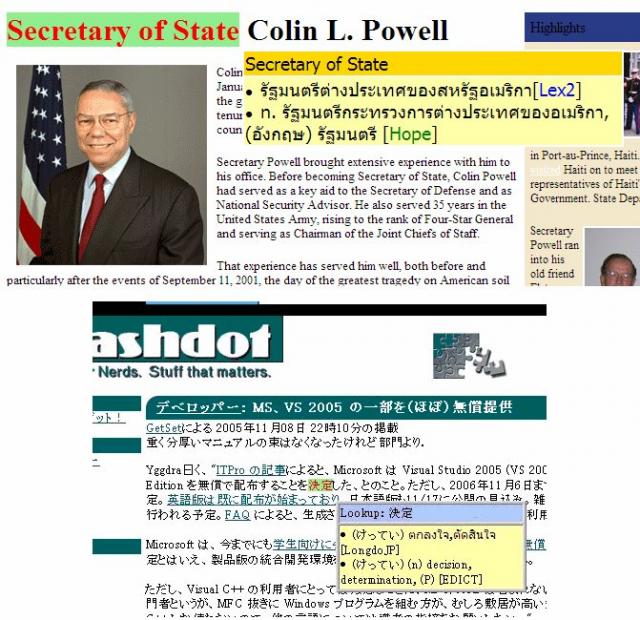
แสดงได้ทั้งความหมายของคำเดี่ยว และคำผสม ได้อย่างถูกต้อง
เช่น Secretary of State=รัฐมนตรีต่างประเทศของสหรัฐฯ (ในภาพตัวอย่าง),
High school=โรงเรียนมัธยมปลาย