(v) disturb in mind or make uneasy or cause to be worried or alarmed, Syn.disorder, unhinge, cark, distract, disquiet, trouble, Example: She was rather perturbed by the news that her father was seriously ill
(v) cause a celestial body to deviate from a theoretically regular orbital motion, especially as a result of interposed or extraordinary gravitational pull, Example: The orbits of these stars were perturbed by the passings of a comet
(v) throw into great confusion or disorder, Syn.derange, throw out of kilter, Example: Fundamental Islamicists threaten to perturb the social order in Algeria and Egypt
(n) activity that is a malfunction, intrusion, or interruption, Syn.disturbance, Example: the term `distress' connotes some degree of perturbation and emotional upset; he looked around for the source of the disturbance; there was a disturbance of neural function
v. t. [ L. perturbare, perturbatum; per + turbare to disturb, fr. turba a disorder: cf. OF. perturber. See Per-, and Turbid. ] 1. To disturb; to agitate; to vex; to trouble; to disquiet. [ 1913 Webster ]
Ye that . . . perturb so my feast with crying. Chaucer. [ 1913 Webster ]
2. To disorder; to confuse. [ R. ] Sir T. Browne. [ 1913 Webster ]
n. [ L. perturbatio: cf. F. perturbation. ] 1. The act of perturbing, or the state of being perturbed; esp., agitation of mind. [ 1913 Webster ]
2. (Astron.) A disturbance in the regular elliptic or other motion of a heavenly body, produced by some force additional to that which causes its regular motion; as, the perturbations of the planets are caused by their attraction on each other. Newcomb. [ 1913 Webster ]
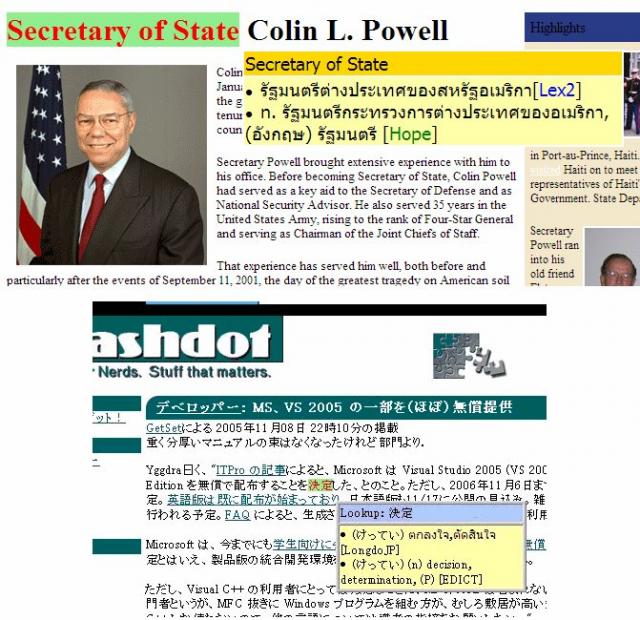
แสดงได้ทั้งความหมายของคำเดี่ยว และคำผสม ได้อย่างถูกต้อง
เช่น Secretary of State=รัฐมนตรีต่างประเทศของสหรัฐฯ (ในภาพตัวอย่าง),
High school=โรงเรียนมัธยมปลาย