v. t. [ imp. & p. p. Behaved p. pr. & vb. n. Behaving. ] [ AS. behabban to surround, restrain, detain (akin to G. gehaben (obs.) to have, sich gehaben to behave or carry one's self); pref. be- + habban to have. See Have, v. t. ] 1. To manage or govern in point of behavior; to discipline; to handle; to restrain. [ Obs. ] [ 1913 Webster ]
He did behave his anger ere 't was spent. Shak. [ 1913 Webster ]
2. To carry; to conduct; to comport; to manage; to bear; -- used reflexively. [ 1913 Webster ]
Those that behaved themselves manfully. 2 Macc. ii. 21. [ 1913 Webster ]
v. i. To act; to conduct; to bear or carry one's self; as, to behave well or ill. [ 1913 Webster ]
☞ This verb is often used colloquially without an adverb of manner; as, if he does not behave, he will be punished. It is also often applied to inanimate objects; as, the ship behaved splendidly. [ 1913 Webster ]
n. Manner of behaving, whether good or bad; mode of conducting one's self; conduct; deportment; carriage; -- used also of inanimate objects; as, the behavior of a ship in a storm; the behavior of the magnetic needle. [ 1913 Webster ]
A gentleman that is very singular in his behavior. Steele. [ 1913 Webster ]
To be upon one's good behavior, To be put upon one's good behavior, to be in a state of trial, in which something important depends on propriety of conduct. -- During good behavior, while (or so long as) one conducts one's self with integrity and fidelity or with propriety. [ 1913 Webster ]
Syn. -- Bearing; demeanor; manner. -- Behavior, Conduct. Behavior is the mode in which we have or bear ourselves in the presence of others or toward them; conduct is the mode of our carrying ourselves forward in the concerns of life. Behavior respects our manner of acting in particular cases; conduct refers to the general tenor of our actions. We may say of soldiers, that their conduct had been praiseworthy during the whole campaign, and their behavior admirable in every instance when they met the enemy. [ 1913 Webster ]
v. t. & i. [ imp. & p. p. Misbehaved p. pr. & vb. n. Misbehaving. ] To behave ill; to conduct one's self improperly; -- often used with a reciprocal pronoun. [ 1913 Webster ]
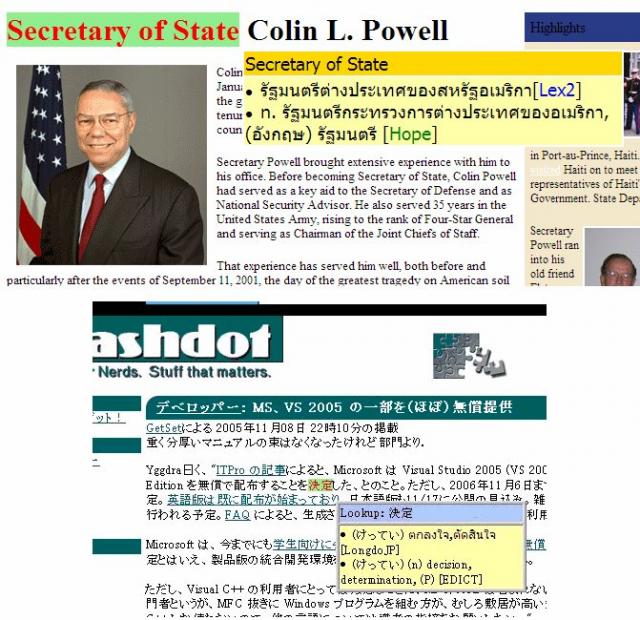
แสดงได้ทั้งความหมายของคำเดี่ยว และคำผสม ได้อย่างถูกต้อง
เช่น Secretary of State=รัฐมนตรีต่างประเทศของสหรัฐฯ (ในภาพตัวอย่าง),
High school=โรงเรียนมัธยมปลาย