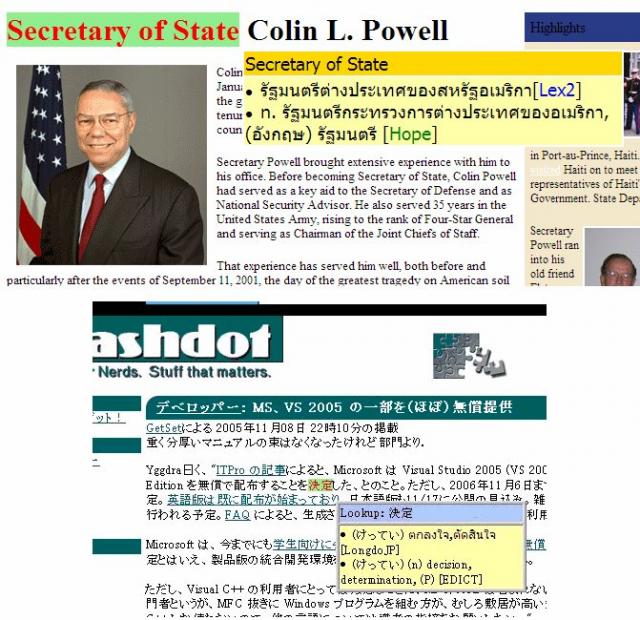
| ลองค้นหาคำในรูปแบบอื่น ๆ เพื่อให้ได้ผลลัพธ์มากขึ้นหรือน้อยลง: -thron-, *thron* |
| throne | (n) บัลลังก์, See also: ที่ประทับ, แท่น, ราชบัลลังก์, พระที่นั่ง, Syn. divan, gaddi, guddee, masnad | | throne | (n) ผู้ครองบัลลังก์, See also: ประมุขผู้ครองบัลลังก์, กษัตริย์, Syn. sovereign | | throne | (n) ตำแหน่งกษัตริย์, See also: อำนาจกษัตริย์ | | throne | (vi) ขึ้นครองบัลลังก์ | | throne | (vt) ทำให้ขึ้นครองบัลลังก์ | | throne | (vi) นั่งบนบัลลังก์ | | throng | (vt) ทำให้เนืองแน่น, See also: ทำให้แน่นขนัด, ทำให้แออัด, ทำให้เบียดเสียด, Syn. crowd, pack | | throng | (vi) มาชุมนุมกัน, See also: มารวมตัวกัน, มารวมกลุ่มกัน, Syn. gather | | throng | (n) ฝูงชน, See also: ประชาชนจำนวนมากที่มาชุมนุมกัน, กลุ่มคน, หมู่คน, Syn. crowd | | throng in | (phrv) จับกลุ่ม, See also: รวมกัน, Syn. crowd in |
| |
| | throne | (โธรน) n. ราชบัลลังก์, บัลลังก์, ตำแหน่งกษัตริย์, อำนาจกษัตริย์, ผู้ครองบัลลังก์, รัฎฐาธิปัตย์, ลำดับชั้นของเทพดา. vt. ทำให้ขึ้นครองบัลลังก์. vi. ขึ้นครองบัลลังก์ | | throng | (ธรอง) n. ฝูงชน, กลุ่มคน, กลุ่ม, จำนวนมากมาย, การชุมนุม, เรื่องราวคับขัน vt., vi. จับกลุ่ม, รวมกลุ่ม, ชุมนุม, แออัด, ออกัน, กลุ้มรุม, Syn. mass | | dethrone | (ดีโธรน') vt. เอาออกจากบัลลังก์, ปลด., See also: dethronement n. ดูdethrone, Syn. depose | | enthrone | (เอนโธรน') vt. ทำให้ขึ้นครองราชย์, ยกย่อง, เอาไปตั้งไว้บนที่สูง, มอบอำนาจให้., See also: enthronement n. ดูenthrone, Syn. inthrone. |
| | throne | (n) บัลลังก์, ราชบัลลังก์ | | throng | (n) ฝูงชน, กลุ่มคน, การจับกลุ่ม, การชุมนุม | | throng | (vi) จับกลุ่ม, ออ, กลุ้มรุม, ชุมนุม | | dethrone | (vt) ปลดออกจากตำแหน่ง, ขับออกจากบัลลังก์ | | dethronement | (n) การปลดออกจากตำแหน่ง, การขับออกจากบัลลังก์ | | enthrone | (vt) ยกขึ้นไว้สูงสุด, ตั้งให้เป็นพระเจ้าแผ่นดิน, ถวายราชสมบัติ, มอบอำนาจให้ |
| | | ราชบัลลังก์ | (n) throne, See also: crown, Example: พระเจ้าฟ้างุ้มถูกปลดออกจากราชบัลลังก์ ต้องเสด็จมาอยู่ที่เมืองน่าน และสวรรคตที่เมืองน่าน, Thai Definition: สถานะความเป็นพระเจ้าแผ่นดิน | | ราชบัลลังก์ | (n) throne, Example: พ่อขุนรามคำแหงเสด็จขึ้นประทับเหนือราชบัลลังก์ให้ประชาชนเข้าเฝ้า, Thai Definition: พระแท่นที่ประทับของพระมหากษัตริย์ภายใต้เศวตฉัตร | | มุง | (v) crowd around, See also: throng, gather around, Example: เมื่อมีคนเป็นลม อย่าให้คนมามุง เพราะจะทำให้อากาศถ่ายเทไม่สะดวก, Thai Definition: รุมกันเข้าไปดูอย่างไม่มีระเบียบ | | ยกโขยง | (v) come in crowds, See also: throng, crowd, flock, Syn. ยกขบวน, ยกพวก, Example: ม็อบนากุ้งกุลาดำยกโขยงกันมาประท้วงรัฐบาลที่หน้าทำเนียบ | | แห่ | (v) flock, See also: throng, crowd, mass, gather, congregate, huddle, Syn. กรู, Example: ชาวบ้านในละแวกนี้แห่กันมาดูรถของเขาราวกับว่ามันเป็นยานอวกาศ, Thai Definition: ไปกันเป็นพวกเป็นหมู่มากๆ | | กลุ่มคน | (n) crowd, See also: throng, group, community, Syn. ฝูงชน, กลุ่มชน, Example: อย่าไปสนใจกลุ่มคนพวกนั้นเลย เพราะมีแต่จะทำให้เรื่องเลวร้ายลงไปอีก, Count Unit: กลุ่ม | | มหาชน | (n) crowd, See also: throng, group, community, Example: หนังสือของท่านได้รับความนิยมชมชอบจากมหาชน, Thai Definition: ชนหมู่มาก, Notes: (บาลี-สันสกฤต) | | พระที่นั่ง | (n) throne-hall, See also: throne, Example: พระที่นั่งพิมานปฐมและพระที่นั่งวัชรีรมยาเป็นสถาปัตยกรรมในรูปแบบไทยประยุกต์, Count Unit: องค์, Thai Definition: สถานที่ออกขุนนาง, Notes: (ราชา) | | พรู | (v) flock, See also: throng, crowd, swarm, Syn. กรู, พรั่งพรู, Example: พอกีฬาเลิกคนก็พรูออกจากสนามแข่งขัน, Thai Definition: อาการที่เคลื่อนไหวมาพร้อมๆ กันเป็นจำนวนมาก | | โพธิบัลลังก์ | (n) throne that the Buddha sit when he became enlightened, Syn. รัตนบัลลังก์, วัชรอาสน์, Example: พระองค์ประทับอยู่บนโพธิบัลลังก์ใต้ต้นพระศรีมหาโพธ, Thai Definition: อาสนะที่พระพุทธเจ้าประทับใต้ต้นพระศรีมหาโพธิ ณ พุทธคยา ประเทศอินเดีย ในวันตรัสรู้ |
| | บัลลังก์ | [banlang] (n) EN: throne FR: trône [ m ] | | เบียด | [bīet] (v) EN: crowd ; flock ; throng ; congregate ; swarm ; mass FR: entasser | | เบียดเสียด | [bīetsīet] (v) EN: crowd ; flock ; throng ; congregate ; swarm ; mass FR: entasser ; écraser | | เบียดเสียดเยียดยัด | [bīetsīet yīetyat] (v, exp) EN: crowd ; be congested ; throng | | ชุมชน | [chumchon] (n) EN: community ; crowd ; mass ; throng FR: communauté [ f ] ; agglomération [ f ] ; quartier [ m ] | | ชุมนุมชน | [chumnumchon] (n) EN: community ; crowd ; mass ; throng ; mob FR: communauté [ f ] ; foule [ f ] | | ฝูงชน | [fūngchon] (n) EN: crowd ; group; throng ; mass ; herd ; flock ; pack ; troop ; mob ; mass of people FR: foule [ f ] ; affluence [ f ] ; peuple [ m ] ; masse [ f ] ; populo [ m ] (fam.) ; multitude [ f ] ; troupe [ f ] ; grappes (humaines) [ fpl ] | | ห้องพระโรง | [Hǿng Phra Rōng] (n, prop) EN: Throne Hall FR: salle du trône [ f ] | | ขึ้นครองราชย์ | [kheun khrøngrāt] (v, exp) EN: ascend the throne | | ครองราชย์ | [khrøngrāt] (v) EN: reign ; succeed to the throne FR: régner |
| | | | | throne | (n) the chair of state for a monarch, bishop, etc., Example: the king sat on his throne | | throne | (n) the position and power of an exalted person (a sovereign or bishop) who is entitled to sit in a chair of state on ceremonial occasions | | throne | (v) sit on the throne as a ruler | | throng | (v) press tightly together or cram, Syn. pack, mob, jam, pile, Example: The crowd packed the auditorium |
| | Throne | n. [ OE. trone, F. trône, L. thronus, Gr. &unr_;; cf. &unr_; a bench, &unr_; a footstool, &unr_; to set one's self, to sit, Skr. dhara&nsdot_;a supporting, dh&rsdot_; to hold fast, carry, and E. firm, a. ] 1. A chair of state, commonly a royal seat, but sometimes the seat of a prince, bishop, or other high dignitary. [ 1913 Webster ] The noble king is set up in his throne. Chaucer. [ 1913 Webster ] High on a throne of royal state. Milton. [ 1913 Webster ] 2. Hence, sovereign power and dignity; also, the one who occupies a throne, or is invested with sovereign authority; an exalted or dignified personage. [ 1913 Webster ] Only in the throne will I be greater than thou. Gen. xli. 40. [ 1913 Webster ] To mold a mighty state's decrees,
And shape the whisper of the throne. Tennyson. [ 1913 Webster ] 3. pl. A high order of angels in the celestial hierarchy; -- a meaning given by the schoolmen. Milton. [ 1913 Webster ] Great Sire! whom thrones celestial ceaseless sing. Young. [ 1913 Webster ] | | Throne | v. t. [ imp. & p. p. Throned p. pr. & vb. n. Throning. ] 1. To place on a royal seat; to enthrone. Shak. [ 1913 Webster ] 2. To place in an elevated position; to give sovereignty or dominion to; to exalt. [ 1913 Webster ] True image of the Father, whether throned
In the bosom of bliss, and light of light. Milton. [ 1913 Webster ] | | Throne | v. i. To be in, or sit upon, a throne; to be placed as if upon a throne. Shak. [ 1913 Webster ] | | Throneless | a. Having no throne. [ 1913 Webster ] | | Throng | v. i. [ imp. & p. p. Thronged p. pr. & vb. n. Thronging. ] To crowd together; to press together into a close body, as a multitude of persons; to gather or move in multitudes. [ 1913 Webster ] I have seen the dumb men throng to see him. Shak. [ 1913 Webster ] | | Throng | v. t. 1. To crowd, or press, as persons; to oppress or annoy with a crowd of living beings. [ 1913 Webster ] Much people followed him, and thronged him. Mark v. 24. [ 1913 Webster ] 2. To crowd into; to fill closely by crowding or pressing into, as a hall or a street. Shak. [ 1913 Webster ] | | Throng | n. [ OE. þrong, þrang, AS. geþrang, fr. þringan to crowd, to press; akin to OS. thringan, D. & G. dringen, OHG. dringan, Icel. þryngva, þröngva, Goth. þriehan, D. & G. drang a throng, press, Icel. þröng a throng, Lith. trenkti to jolt, tranksmas a tumult. Cf. Thring. ] 1. A multitude of persons or of living beings pressing or pressed into a close body or assemblage; a crowd. [ 1913 Webster ] 2. A great multitude; as, the heavenly throng. [ 1913 Webster ] Syn. -- Throng, Multitude, Crowd. Any great number of persons form a multitude; a throng is a large number of persons who are gathered or are moving together in a collective body; a crowd is composed of a large or small number of persons who press together so as to bring their bodies into immediate or inconvenient contact. A dispersed multitude; the throngs in the streets of a city; the crowd at a fair or a street fight. But these distinctions are not carefully observed. [ 1913 Webster ] So, with this bold opposer rushes on
This many-headed monster, multitude. Daniel. [ 1913 Webster ] Not to know me argues yourselves unknown,
The lowest of your throng. Milton. [ 1913 Webster ] I come from empty noise, and tasteless pomp,
From crowds that hide a monarch from himself. Johnson. [ 1913 Webster ] | | Throng | a. Thronged; crowded; also, much occupied; busy. [ Obs. or Prov. Eng. ] Bp. Sanderson. [ 1913 Webster ] To the intent the sick . . . should not lie too throng. Robynson (More's Utopia). [ 1913 Webster ] | | Throngly | adv. In throngs or crowds. [ Obs. ] [ 1913 Webster ] |
| | | 上 | [じょう, jou] (n, adj-no, n-adv, n-suf) (1) above; up; over; elder (e.g. daughter); (2) top; summit; (3) surface; on; (4) before; previous; (5) superiority; one's superior (i.e. one's elder); (6) on top of that; besides; what's more; (7) upon (further inspection, etc.); based on (and occurring after); (8) matters concerning...; as concerns ...; (9) (as ...上は) since (i.e. "for that reason"); (n-suf) (10) (hon) (See 父上) suffix indicating higher social standing; (11) (arch) place of one's superior (i.e. the throne); (12) (arch) emperor; sovereign; shogun; daimyo; (13) (arch) noblewoman (esp. the wife of a nobleman); (P) #111 [Add to Longdo] | | 位 | [くらい, kurai] (adv, suf) (1) (orig. from 座居, meaning "seat") throne; crown; (nobleman's) seat; (2) (See 位階) government position; court rank; (3) social standing; rank; class; echelon; rung; (n) (4) grade (of quality, etc.); level; tier; rank; (5) (See 桁・2) digit (e.g. the tens, the hundreds, etc.); place; (6) (See どの位) degree; extent; amount; (P) #116 [Add to Longdo] | | 代 | [だい, dai] (n, n-suf) (1) charge; cost; price; (2) (See 台・だい・6) generation; age; reign; (3) (geological) era; (4) (after someone's name or title) a representative of; on behalf of; for (someone); (5) (See 代表電話番号) used after a phone number to indicate that it is a switchboard number; (ctr) (6) (See 台・だい・6) counter for decades of ages, eras, etc.; (7) counter for generations (of inheritors to a throne, etc.); (8) (abbr) (See 代理申請会社) proxy application company #376 [Add to Longdo] | | 王座 | [おうざ, ouza] (n) throne; (P) #1,539 [Add to Longdo] | | 即位 | [そくい, sokui] (n, vs) enthronement; (P) #4,606 [Add to Longdo] | | 王位 | [おうい, oui] (n) the throne; the crown; (P) #5,941 [Add to Longdo] | | 就く(P);即く | [つく, tsuku] (v5k) (1) (See 付く・つく・1) to ascend (the throne); to accede; (2) (就く only) to take (seat, position, course, etc.); to assume; (3) (就く only) to start (on a journey); to commence; to depart; (4) (就く only) to study (under teacher); to be an apprentice; (P) #12,618 [Add to Longdo] | | 皇位 | [こうい, koui] (n) imperial throne; (P) #17,503 [Add to Longdo] | | 踏む(P);履む;践む | [ふむ, fumu] (v5m, vt) (1) to step on; to tread on; (2) to experience; to undergo; (3) to estimate; to value; to appraise; (4) to rhyme; (5) (arch) to inherit (the throne, etc.); (6) to follow (rules, morals, principles, etc.); (P) #18,001 [Add to Longdo] | | ミゾレフグ | [mizorefugu] (n) spotted pufferfish (Arothron meleagris) [Add to Longdo] |
| |
add this word
You know the meaning of this word? click [add this word] to add this word to our database with its meaning, to impart your knowledge for the general benefit
Are you satisfied with the result?
Discussions | |
|