v. t. 1. To injure, as a lance, without breaking it; also, to break, as a lance, but usually in an unknightly or unscientific manner. [ Obs. ] [ 1913 Webster ]
Do not fear; I have A staff to taint, and bravely. Massinger. [ 1913 Webster ]
2. To hit or touch lightly, in tilting. [ Obs. ] [ 1913 Webster ]
They tainted each other on the helms and passed by. Ld. Berners. [ 1913 Webster ]
n. [ Cf. F. atteinte a blow, bit, stroke. See Attaint. ] 1. A thrust with a lance, which fails of its intended effect. [ Obs. ] [ 1913 Webster ]
This taint he followed with his sword drawn from a silver sheath. Chapman. [ 1913 Webster ]
2. An injury done to a lance in an encounter, without its being broken; also, a breaking of a lance in an encounter in a dishonorable or unscientific manner. [ Obs. ] [ 1913 Webster ]
v. t. [ F. teint, p. p. of teindre to dye, tinge, fr. L. tingere, tinctum. See Tinge, and cf. Tint. ] 1. To imbue or impregnate with something extraneous, especially with something odious, noxious, or poisonous; hence, to corrupt; to infect; to poison; as, putrid substance taint the air. [ 1913 Webster ]
2. Fig.: To stain; to sully; to tarnish. [ 1913 Webster ]
His unkindness may defeat my life, But never taint my love. Shak. [ 1913 Webster ]
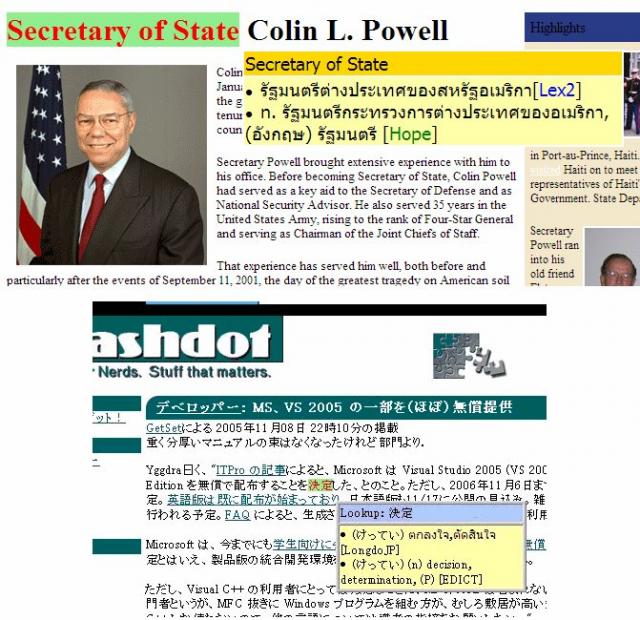
แสดงได้ทั้งความหมายของคำเดี่ยว และคำผสม ได้อย่างถูกต้อง
เช่น Secretary of State=รัฐมนตรีต่างประเทศของสหรัฐฯ (ในภาพตัวอย่าง),
High school=โรงเรียนมัธยมปลาย