(n) herb of pasture and open woodland throughout most of Europe and western Asia having orange-yellow daisylike flower heads that when dried are used as a stimulant and to treat bruises and swellings
(n) United States general and traitor in the American Revolution; in 1780 his plan to surrender West Point to the British was foiled (1741-1801), Syn.Benedict Arnold
(n) Italian theologian who censured the worldly possessions of monks and the temporal power of bishops and was condemned for dogmatic errors by the Second Lateran Council (early 12th century)
The Collaborative International Dictionary of English (GCIDE) v.0.53
{ ‖‖ } n. [ Turk. Arnaut, fr. NGr. &unr_;, for &unr_;. ] An inhabitant of Albania and neighboring mountainous regions, specif. one serving as a soldier in the Turkish army. [ Webster 1913 Suppl. ]
n. [ Prob. a corruption of ptarmica. ] (Bot.) A genus of plants; also, the most important species (Arnica montana), native of the mountains of Europe, used in medicine as a narcotic and stimulant. [ 1913 Webster ]
☞ The tincture of arnica is applied externally as a remedy for bruises, sprains, etc. [ 1913 Webster ]
/mhw>, n. [ Perh. the native name. ] A red or yellowish-red dyeing material, prepared from the pulp surrounding the seeds of a tree (Bixa orellana) belonging to the tropical regions of America. It is used for coloring cheese, butter, etc. [ Written also Anatto, Anatta, Annatto, Annotta, etc. ] [ 1913 Webster ]
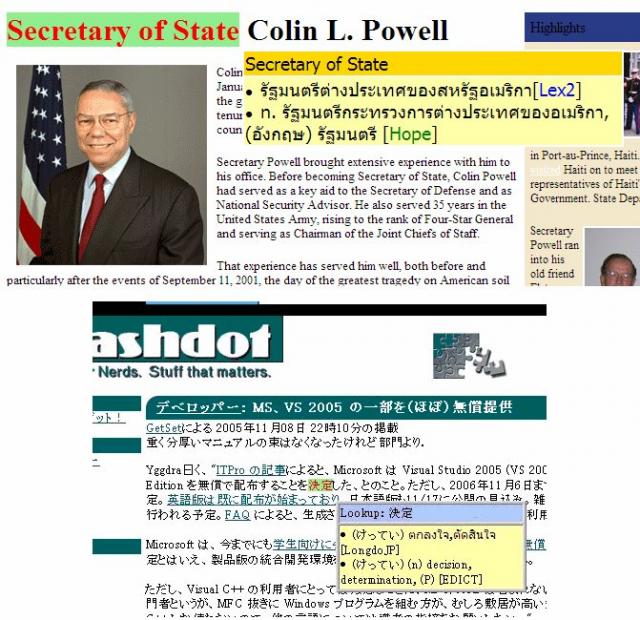
แสดงได้ทั้งความหมายของคำเดี่ยว และคำผสม ได้อย่างถูกต้อง
เช่น Secretary of State=รัฐมนตรีต่างประเทศของสหรัฐฯ (ในภาพตัวอย่าง),
High school=โรงเรียนมัธยมปลาย