n. [ Sp., from Ar. nā'ūra. ] A large water wheel, turned by the action of a stream against its floats, and carrying at its circumference buckets, by which water is raised and discharged into a trough; used in Arabia, China, and elsewhere for irrigating land; a Persian wheel. [ 1913 Webster ]
n. [ F., fr. Norvège Norway . ] (Min.) A granular crystalline rock consisting essentially of a triclinic feldspar (as labradorite) and hypersthene. [ 1913 Webster ]
n. [ NL. ] (Chem.) A supposed metal alleged to have been discovered in 1845 by the Swedish chemist Swanberg in zircon. After many unsuccessful attempts to verify this new element, the element named Hafnium (atomic number 72) was discoverd in 1923 by D. Coster and G. von Hevesey in the zirconium-containing mineral zircon. Hafnium, present at 1 to 5% in many zirconium-bearing minerals, but difficult to separate from zirconium, is probably the element that gave rise to the properties attributed to the hypothetical norium. [ 1913 Webster +PJC ]
[のり, nori] (n, n-suf) (1) riding; ride; (2) spread (of paints); (3) (two)-seater; (4) (uk) (possibly from 気乗り) mood (as in to pick up on and join in with someone's mood); (P) #5,361[Add to Longdo]
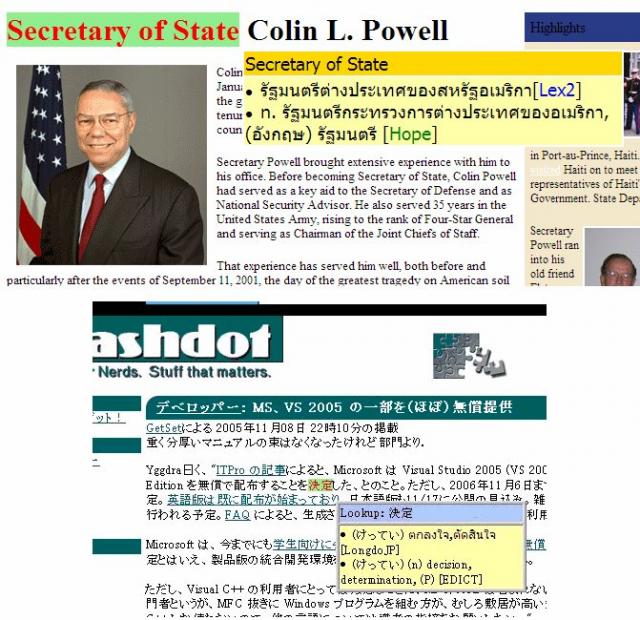
แสดงได้ทั้งความหมายของคำเดี่ยว และคำผสม ได้อย่างถูกต้อง
เช่น Secretary of State=รัฐมนตรีต่างประเทศของสหรัฐฯ (ในภาพตัวอย่าง),
High school=โรงเรียนมัธยมปลาย