[あたまのうえのはえもおえない(頭の上の蠅も追えない);あたまのはえもおえない(頭の蠅も追えない), atamanouenohaemooenai ( atama no ueno hae mo oe nai ); atamanohaemooenai ( atama no] (exp) unable even to drive away the flies on one's own head (denoting a helpless person) [Add to Longdo]
You know the meaning of this word? click [add this word] to add this word to our database with its meaning, to impart your knowledge for the general benefit
ติดโพย (PopThai)
Move your mouse over the text to see pop-up windows.
(がしら) (suf) (1) (after a noun) top of ..; head of ..; (2) (after the -masu stem of a verb) the moment that .. [EDICT]
(とう) (ctr) counter for large animals (e.g. head of cattle); (P) [EDICT]
(あたま(頭)(P);かしら(P);かぶり(頭);こうべ;ず(頭);つむり(頭);つぶり(頭);つむ(頭);かぶ(頭)(ok)) (n) (1) head; (2) (あたま only) mind; brain; intellect; (3) (あたま, かしら only) top; (4) (あたま, かしら only) hair (on one's head); (5) (つむり only) bangs; fringe; (6) (かしら only) top structural component of a kanji; (P) [EDICT]
(tóu, ㄊㄡˊ) head; hair style; the top; end; beginning or end; a stub; remnant; chief; boss; side; aspect; first; leading; classifier for pigs or livestock [CE-DICT]
(tou, ㄊㄡ˙) suff. for nouns [CE-DICT]
の
() (prt) endorsing and questioning the preceding statement (sentence ending particle); lamenting reflections on the preceding statement (sentence ending particle) [EDICT]
() (prt) (1) although; when; and yet; despite this; in spite of; even though; but even so; but even then; however; nevertheless; for all that; notwithstanding that; (2) while; (3) if only; I wish; (4) I tell you; you should do; (5) in order to; (P) [EDICT]
(之) (prt) (arch) possessive (used on tombs, etc.) [EDICT]
(幅) (n,n-suf,ctr) (after a number in the hito-, futa-, mi- counting system) unit of measurement for cloth breadth (30-38 cm) [EDICT]
(布) (n,n-suf,ctr) (after a number in the hito-, futa-, mi- counting system) unit of measurement for cloth breadth (30-38 cm) [EDICT]
(箆) (n) (1) (arch) shaft (of an arrow); (2) (arch) (See 矢竹・2) arrow bamboo (Pseudosasa japonica) [EDICT]
(篦) (n) (1) (arch) shaft (of an arrow); (2) (arch) (See 矢竹・2) arrow bamboo (Pseudosasa japonica) [EDICT]
上
(かみ) ยอด, ส่วนบน, ข้างบน [LongdoJP]
(うえ) (n,adj-no,n-adv,n-suf) (1) above; up; over; elder (e.g. daughter); (2) top; summit; (3) surface; on; (4) before; previous; (5) superiority; one's superior (i.e. one's elder); (6) on top of that; besides; what's more; (7) upon (further inspection, etc.); based on (and occurring after); (8) matters concerning...; as concerns ...; (9) (as ...上は) since (i.e. "for that reason"); (n-suf) (10) (hon) (See 父上) suffix indicating higher social standing; (11) (arch) place of one's superior (i.e. the throne); (12) (arch) emperor; sovereign; shogun; daimyo; (13) (arch) noblewoman (esp. the wife of a nobleman); (P) [EDICT]
(うわ) (n,pref) upper; upward; outer; surface; top [EDICT]
(かみ) (n) (1) (ant [EDICT]
(じょう) (n-suf) (1) from the standpoint of; as a matter of (e.g. fact); in the field of; being of the type of; (2) aboard (a ship or vehicle); on top of; on; above; (n) (3) (See 下・げ・2) first volume (e.g. book); (n,pref) (4) superior quality; best; top; high class; (5) going up; (6) governmental; imperial; (7) presenting; showing; (pref) (8) ana- (medical, biol.); (P) [EDICT]
(shàng, ㄕㄤˋ) on; on top; upon; first (of two parts); previous or last (week etc); upper; higher; above; previous; to climb; to go into; above; to go up; to attend (class or university); third tone of putonghua [CE-DICT]
蠅
(はえ) (n) (1) (uk) fly (of infraorder Muscomorpha); (2) (derog) person of no worth; pisher; scrub; (P) [EDICT]
(yíng, ㄧㄥˊ) fly; musca [CE-DICT]
も
() (adv,int) (1) (See すでに) already; anymore; (2) soon; shortly; (3) more; further; other; again; (int,adv) (4) interjection used to strengthen expression of an emotion (often exasperation); (P) [EDICT]
() (n) (from a reversal of くも) (See 雲・くも) cigarette; cig; smoke; fag [EDICT]
() (int) excuse me! (when calling out to someone) [EDICT]
() (adv) (abbr) (col) (See 勿論・もちろん) of course; for sure; definitely [EDICT]
() (pref) (before a verb) (See もて囃す,もて扱う・1) emphatic prefix [EDICT]
(裳) (n) ancient skirt [EDICT]
(喪) (n,adj-no) mourning; (P) [EDICT]
(藻) (n) duckweed; seaweed; algae; (P) [EDICT]
ない
() (exp) (1) (See ませんか) (used to ask a question in the negative) won't (hasn't, isn't, doesn't, etc.); (2) (used to make invitations, express desires or give indirect commands) won't you [EDICT]
() (conj,aux) (1) (See ない) without doing ...; (aux) (2) used in sentence-final position as an indirect prohibition [EDICT]
(内) (suf) inside; within [EDICT]
(亡い) (adj-i) (See 無い) dead [EDICT]
(無い) (adj-i) (1) (uk) (See 亡い) nonexistent; not being (there); (2) unpossessed; unowned; not had; (3) (See またとない) unique; (4) (as ...ことがない, etc.) indicates negation, inexperience, unnecessariness or impossibility; (aux-adj) (5) (See ない) (after the ren'youkei form of an adjective) not ...; (6) (after the -te form of a verb) to not be...; to have not ...; (P) [EDICT]
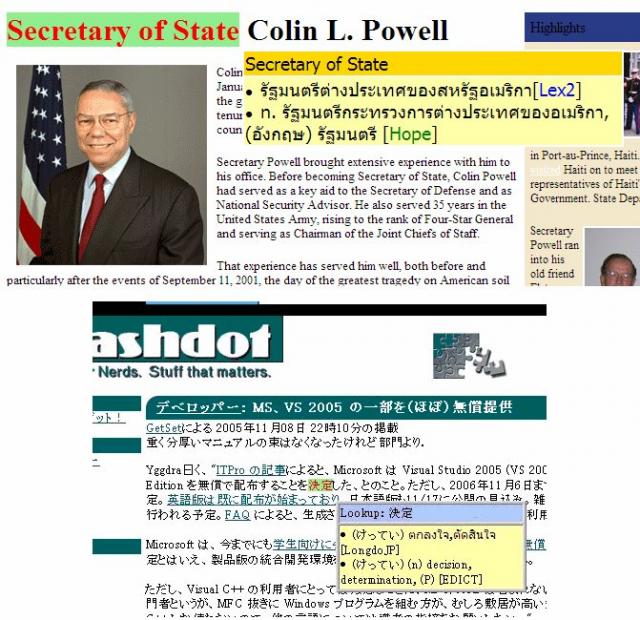
แสดงได้ทั้งความหมายของคำเดี่ยว และคำผสม ได้อย่างถูกต้อง
เช่น Secretary of State=รัฐมนตรีต่างประเทศของสหรัฐฯ (ในภาพตัวอย่าง),
High school=โรงเรียนมัธยมปลาย