(り) (n) (1) reason; principle; logic; (2) {Buddh} (See 事・じ) general principle (as opposed to individual concrete phenomenon); (3) (in neo-Confucianism) the underlying principles of the cosmos; (P) [EDICT]
(ことわり) (n) (See 道理) reason; truth; way of things; justice [EDICT]
(lǐ, ㄌㄧˇ) texture; grain (of wood); inner essence; intrinsic order; reason; logic; truth; science; natural science (esp. physics); to manage; to pay attention to; to run (affairs); to handle; to put in order; to tidy up [CE-DICT]
性
(しょう) (n,n-suf) (1) nature (of a person or thing); (2) {Buddh} that which does not change according to external influences [EDICT]
(xìng, ㄒㄧㄥˋ) nature; character; property; quality; attribute; sexuality; sex; gender; surname; suffix forming adjective from verb; suffix forming noun from adjective, corresponding to -ness or -ity; essence [CE-DICT]
批
(pī, ㄆㄧ) to ascertain; to act on; to criticize; to pass on; classifier for batches, lots, military flights; tier (for the ranking of universities and colleges) [CE-DICT]
判
(はん(P);ばん) (n) (1) (はん only) seal; stamp; monogram signature; (2) (はん only) judgment; judgement; (n,n-suf) (3) (See 判型) size (of paper or books); (P) [EDICT]
(pàn, ㄆㄢˋ) to judge; to sentence; to discriminate; to discern [CE-DICT]
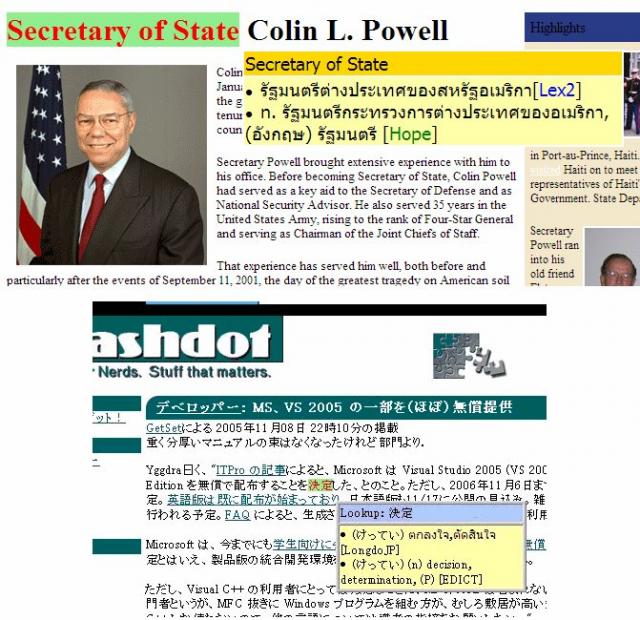
แสดงได้ทั้งความหมายของคำเดี่ยว และคำผสม ได้อย่างถูกต้อง
เช่น Secretary of State=รัฐมนตรีต่างประเทศของสหรัฐฯ (ในภาพตัวอย่าง),
High school=โรงเรียนมัธยมปลาย