() (prt,conj) among other things; such things as; or something like that; (P) [EDICT]
() (n) regular (stops at every station) Jouetsu-line Shinkansen [EDICT]
() (prt) (1) even; (2) even if; even though; (3) because of; on the grounds that [EDICT]
() (prt) indicates word or phrase being defined; (P) [EDICT]
() (n) (sl) last (in a contest) [EDICT]
() (prt) (1) certainly; of course; to be sure; surely; (2) even if; no matter (who, what, when, where, why, how); though; although; (3) (with neg. verb) without even; without so much as; (4) (after an adverb) (See 遅くとも) at the (least, earliest, etc.); (5) (sometimes esp. an emphatic form of the particle と) (See と・1,と・2,と・3,と・4) emphatic particle; (P) [EDICT]
() (v5r) (equiv. of -ている indicating continuing action as a verb ending; poss. contraction of -て ending + おる auxiliary verb) is being [EDICT]
() (n) fatty, more expensive tuna meat; (P) [EDICT]
() (adv-to,adv) (on-mim) tap; knock; bonk [EDICT]
(戸) (n) (1) (戸 only) (See 扉) door (esp. Japanese-style); (2) (arch) entrance (to a home); (3) (arch) narrows; (P) [EDICT]
(門) (n) (1) (戸 only) (See 扉) door (esp. Japanese-style); (2) (arch) entrance (to a home); (3) (arch) narrows; (P) [EDICT]
(人) (suf) person [EDICT]
(徒) (n) party; set; gang [EDICT]
(斗) (n) (1) (obs) to (measure of volume, approx. 18 litres); (2) (See 枡形) square bearing block (at the top of a pillar); (3) (See 二十八宿) Chinese "Dipper" constellation (one of the 28 mansions); (P) [EDICT]
(途) (n) way; (P) [EDICT]
(都) (n,adj-no) metropolitan; municipal [EDICT]
する
() (conj) thereupon; hereupon; (P) [EDICT]
() (adv,adv-to) (on-mim) with a smooth, unhindered motion; speedily and without delay [EDICT]
(為る) (vs-i) (1) (uk) to do; (2) to cause to become; to make (into); to turn (into); (3) to serve as; to act as; to work as; (4) to wear (clothes, a facial expression, etc.); (5) (as 〜にする,〜とする) to judge as being; to view as being; to think of as; to treat as; to use as; (6) to decide on; to choose; (vs-i,vi) (7) (as 〜がする) to be sensed (of a smell, noise, etc.); (8) to be (in a state, condition, etc.); (9) to be worth; to cost; (10) to pass (of time); to elapse; (suf,vs-i) (11) verbalizing suffix (applies to nouns noted in this dictionary with the part of speech "vs"); (aux-v,vs-i) (12) (See お願いします,御・お) creates a humble verb (after a noun prefixed with "o" or "go"); (13) (as 〜うとする,〜ようとする) (See とする・1) to be just about to; to be just starting to; to try to; to attempt to; (P) [EDICT]
(刷る) (v5r,vt) (1) to print; (2) to color or pattern fabric using a wooden mold; (P) [EDICT]
(摺る) (v5r,vt) (1) to print; (2) to color or pattern fabric using a wooden mold; (P) [EDICT]
(擦る) (v5r,vt) (1) to rub; to chafe; to strike (match); to file; to frost (glass); (2) to lose (e.g. a match); to forfeit; to squander one's money (e.g. through gambling, Pachinko, etc.); (P) [EDICT]
(摩る) (v5r,vt) (1) to rub; to chafe; to strike (match); to file; to frost (glass); (2) to lose (e.g. a match); to forfeit; to squander one's money (e.g. through gambling, Pachinko, etc.); (P) [EDICT]
(磨る) (v5r,vt) (1) to rub; to chafe; to strike (match); to file; to frost (glass); (2) to lose (e.g. a match); to forfeit; to squander one's money (e.g. through gambling, Pachinko, etc.); (P) [EDICT]
(擂る) (v5r,vt) (1) to rub; to chafe; to strike (match); to file; to frost (glass); (2) to lose (e.g. a match); to forfeit; to squander one's money (e.g. through gambling, Pachinko, etc.); (P) [EDICT]
(掏る) (v5r,vt) (See 掏摸) to pick someone's pocket [EDICT]
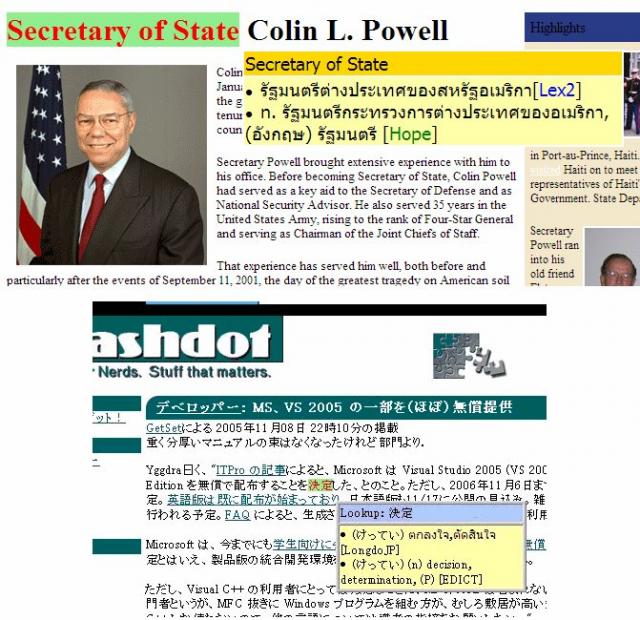
แสดงได้ทั้งความหมายของคำเดี่ยว และคำผสม ได้อย่างถูกต้อง
เช่น Secretary of State=รัฐมนตรีต่างประเทศของสหรัฐฯ (ในภาพตัวอย่าง),
High school=โรงเรียนมัธยมปลาย