You know the meaning of this word? click [add this word] to add this word to our database with its meaning, to impart your knowledge for the general benefit
ติดโพย (PopThai)
Move your mouse over the text to see pop-up windows.
(さま) (n,suf) (1) (pol) Mr, Mrs or Ms; (2) (See お粗末さまでした) used (gen. in fixed expressions) to make words more polite; (3) manner; kind; appearance; (P) [EDICT]
(よう) (n-suf,n) (1) (uk) (See 様だ) (usu. after the -masu stem of a verb) appearing ...; looking ...; (2) (usu. after the -masu stem of a verb) way to ...; method of ...ing; (3) (usu. after a noun) form; style; design; (4) (usu. after a noun) like; similar to; (n) (5) thing (thought or spoken); (P) [EDICT]
(ざま) (n) (1) mess; sorry state; plight; sad sight; (suf) (2) (See 様・さま) way; manner [EDICT]
(yàng, ㄧㄤˋ) Japanese variant of 样 [CE-DICT]
相
(こもごも) (adv) (uk) alternately; in succession [EDICT]
(lùn, ㄌㄨㄣˋ) by the; per; discuss; theory; to talk (about); to discuss [CE-DICT]
理
(り) (n) (1) reason; principle; logic; (2) {Buddh} (See 事・じ) general principle (as opposed to individual concrete phenomenon); (3) (in neo-Confucianism) the underlying principles of the cosmos; (P) [EDICT]
(ことわり) (n) (See 道理) reason; truth; way of things; justice [EDICT]
(lǐ, ㄌㄧˇ) texture; grain (of wood); inner essence; intrinsic order; reason; logic; truth; science; natural science (esp. physics); to manage; to pay attention to; to run (affairs); to handle; to put in order; to tidy up [CE-DICT]
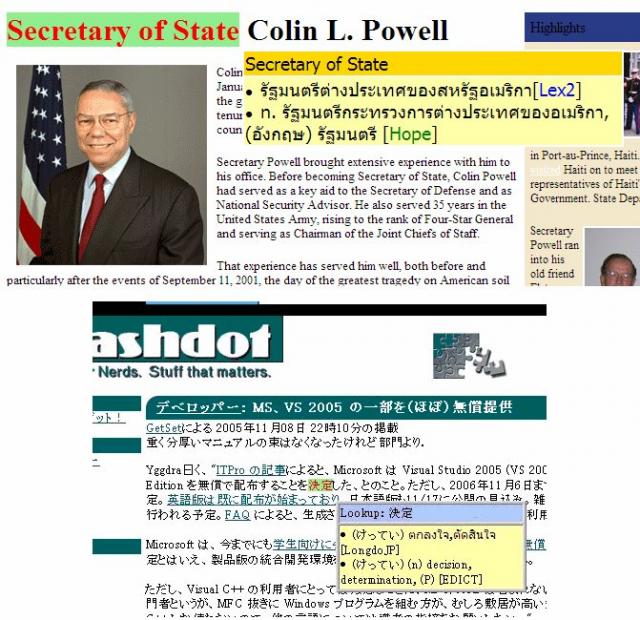
แสดงได้ทั้งความหมายของคำเดี่ยว และคำผสม ได้อย่างถูกต้อง
เช่น Secretary of State=รัฐมนตรีต่างประเทศของสหรัฐฯ (ในภาพตัวอย่าง),
High school=โรงเรียนมัธยมปลาย