(おもう) (v5u,vt) (1) (想う has connotations of heart-felt) to think; to consider; to believe; (2) to think (of doing); to plan (to do); (3) to judge; to assess; to regard; (4) to imagine; to suppose; to dream; (5) to expect; to look forward to; (6) to feel; to desire; to want; (7) to recall; to remember; (P) [EDICT]
せる
() (aux-v,v, ) (1) (せる is for 五段 verbs, させる for 一段; follows the imperfective form of (v5) and (vs) verbs; senses 1-3 of せる are sometimes abbreviated as 〜す) auxiliary verb indicating the causative; (2) (hum) (usu. as 〜(さ)せてもらう, 〜(さ)せていただく, etc.) auxiliary verb indicating that one has been granted the permission to do something; (3) auxiliary verb used to make verbs more "active"; (4) (hon) (as 〜(さ)せられる, 〜あら(さ)せられる, 〜(さ)せ給う, etc.) auxiliary verb used as an extreme honorific for others' actions [EDICT]
(競る) (v5r,vt) (1) to compete; (2) to bid; (3) to sell at auction; (P) [EDICT]
(糶る) (v5r,vt) (1) to compete; (2) to bid; (3) to sell at auction; (P) [EDICT]
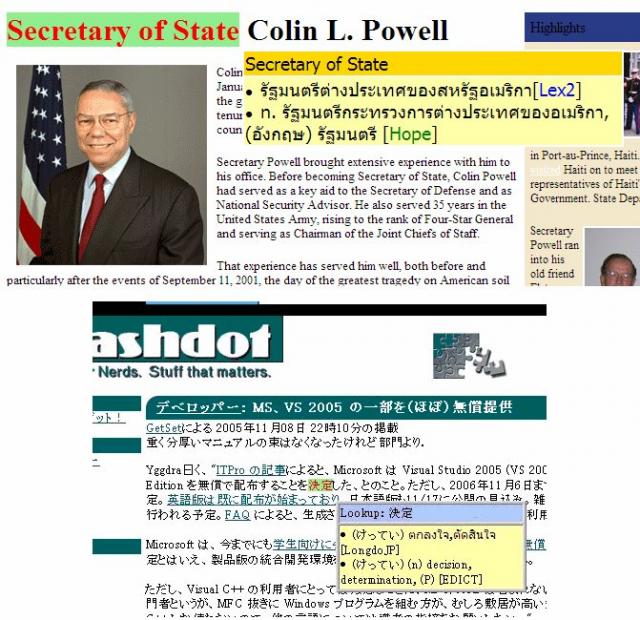
แสดงได้ทั้งความหมายของคำเดี่ยว และคำผสม ได้อย่างถูกต้อง
เช่น Secretary of State=รัฐมนตรีต่างประเทศของสหรัฐฯ (ในภาพตัวอย่าง),
High school=โรงเรียนมัธยมปลาย