You know the meaning of this word? click [add this word] to add this word to our database with its meaning, to impart your knowledge for the general benefit
ติดโพย (PopThai)
Move your mouse over the text to see pop-up windows.
(ひら;ヒラ) (n) (1) something broad and flat; palm of the hand; (2) common; ordinary; (3) (abbr) (See 平社員) low-ranking employee; freshman; novice; private [EDICT]
(píng, ㄆㄧㄥˊ) flat; level; equal; to tie (make the same score); to draw (score); calm; peaceful; level or even tone (i.e. first and second tones in classical Chinese); surname Ping [CE-DICT]
等
(とう) (n,n-suf,ctr) (1) class; order; rank; (suf) (2) (See 等・など) et cetera (etc.); and the like; (pref) (3) equal [EDICT]
(ら) (suf) (1) pluralizing suffix (often humble, derogatory or familiar); and others; et alios; and the like; and followers; (2) (See あちら,いくら) or so (rough indicator of direction, location, amount, etc.); (3) (See 清ら) (after the stem of an adjective) nominalizing suffix [EDICT]
(など) (n,n-suf,prt) (1) (uk) et cetera; etc.; and the like; and so forth; (2) (indicating an approximate quote or vague suggestion) or something; (3) (lessening the significance or value of the previous word) the likes of; (P) [EDICT]
(děng, ㄉㄥˇ) class; rank; grade; equal to; same as; wait for; await; et cetera; and so on; et al. (and other authors); after; as soon as; once [CE-DICT]
的
(てき) (adj-na,suf) -like; typical; (P) [EDICT]
(まと) (n) mark; target; (P) [EDICT]
(de, ㄉㄜ˙) of; structural particle: used before a noun, linking it to preceding possessive or descriptive attributive [CE-DICT]
(fǎ, ㄈㄚˇ) law; method; way; Buddhist teaching; Legalist; abbr. for France [CE-DICT]
律
(りつ) (n) (1) law (esp. ancient East Asian criminal code); regulation; (2) {Buddh} vinaya (rules for the monastic community); (3) (abbr) (See 律宗) Ritsu (school of Buddhism); (4) (abbr) (See 律詩) lushi (style of Chinese poem); (5) (also りち) (musical) pitch; (6) (See 十二律,呂) six odd-numbered notes of the ancient chromatic scale; (7) (abbr) (See 律旋) Japanese seven-tone gagaku scale, similar to Dorian mode (corresponding to [EDICT]
(lǜ, ㄌㄩˋ) law [CE-DICT]
地
(じ) (n) (1) (abbr) ground; land; earth; soil; (2) the region in question; the local area; (3) skin; (4) texture; fabric; material; weave; (5) base; background; (6) one's true nature; (7) narrative (i.e. descriptive part of a story); (8) real life; actuality; (9) (in the game of go) captured territory; (10) (See 地謡) noh chorus; (11) (in Japanese dance) accompaniment music; (12) (in Japanese music) basic phrase (usu. repetitive); (13) base part (of multiple shamisens) [EDICT]
(ち) (n,n-suf) (1) earth; ground; land; soil; (2) place; (3) territory; (4) (See 天地無用) bottom (of a package, book, etc.); (5) (See 五大・1,土・ど・2) earth (one of the five elements); (P) [EDICT]
(つち(P);つし(地)) (n) (1) earth; soil; dirt; (2) the earth (historically, esp. as opposed to the heavens); the ground; the land; (3) (See 鳥の子紙) low-quality torinoko-gami (containing mud); (4) (also written as 犯土, 椎, 槌) (See 陰陽道) (period of) refraining from construction in the direction of the god of the earth (in On'youdou); (P) [EDICT]
(de, ㄉㄜ˙) -ly; structural particle: used before a verb or adjective, linking it to preceding modifying adverbial adjunct [CE-DICT]
(dì, ㄉㄧˋ) earth; ground; field; place; land [CE-DICT]
位
(い) (ctr) (1) rank; place (e.g. first place); (2) decimal place; (3) counter for ghosts; (P) [EDICT]
(くらい) (adv,suf) (1) (orig. from 座居, meaning "seat") throne; crown; (nobleman's) seat; (2) (See 位階) government position; court rank; (3) social standing; rank; class; echelon; rung; (n) (4) grade (of quality, etc.); level; tier; rank; (5) (See 桁・2) digit (e.g. the tens, the hundreds, etc.); place; (6) (See どの位) degree; extent; amount; (P) [EDICT]
(wèi, ㄨㄟˋ) position; location; classifier for people; place; seat; classifier for binary bits (e.g. 十六位 16-bit or 2 bytes) [CE-DICT]
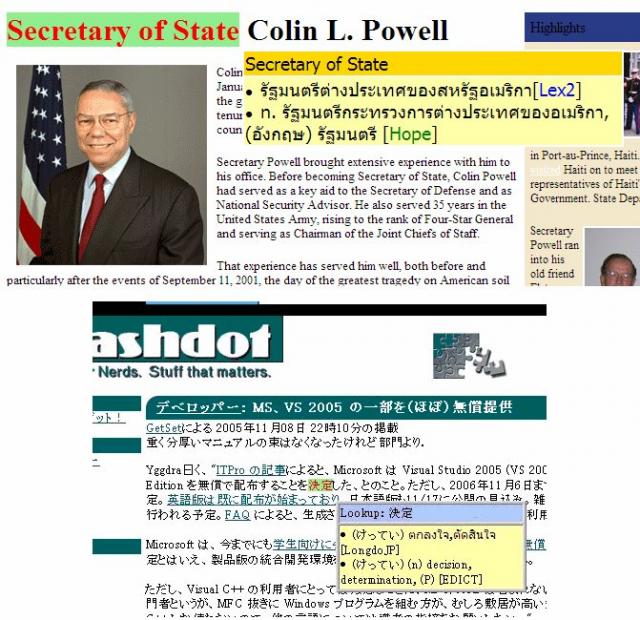
แสดงได้ทั้งความหมายของคำเดี่ยว และคำผสม ได้อย่างถูกต้อง
เช่น Secretary of State=รัฐมนตรีต่างประเทศของสหรัฐฯ (ในภาพตัวอย่าง),
High school=โรงเรียนมัธยมปลาย