(ぜん) (n-pref) (1) (See 前・まえ) the last (i.e. immediately preceding) (e.g. "the last mayor"); previous; one-time; former; (2) (before the name of an era) pre- (e.g. "premodern"); (adj-no,n) (3) before; earlier; (P) [EDICT]
(まえ) (n-adv,n-t,suf) (1) (See 前・ぜん) ago; before (some event); previously; (minutes) to (the hour); (2) in front (of); before (e.g. the house); (3) head (of a line); front (e.g. of a bus); fore part; (4) in the presence of; (5) (See 人前・にんまえ) helping; portion; (6) privates; private parts; (P) [EDICT]
(qián, ㄑㄧㄢˊ) before; in front; ago; former; previous; earlier; front [CE-DICT]
進
(jìn, ㄐㄧㄣˋ) to advance; to enter; to come in [CE-DICT]
運
(うん) (n) fortune; luck; (P) [EDICT]
(yùn, ㄩㄣˋ) to move; to transport; to use; to apply; fortune; luck; fate [CE-DICT]
動
(どう) (n) motion; change; confusion; (P) [EDICT]
(dòng, ㄉㄨㄥˋ) to use; to act; to move; to change [CE-DICT]
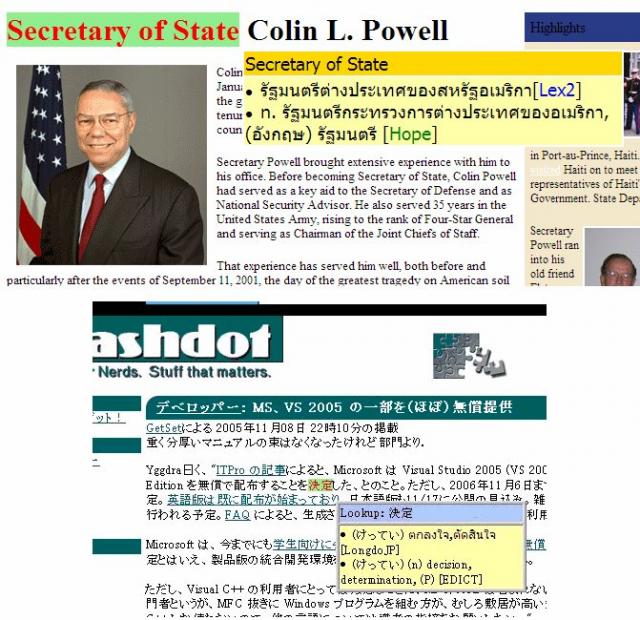
แสดงได้ทั้งความหมายของคำเดี่ยว และคำผสม ได้อย่างถูกต้อง
เช่น Secretary of State=รัฐมนตรีต่างประเทศของสหรัฐฯ (ในภาพตัวอย่าง),
High school=โรงเรียนมัธยมปลาย