You know the meaning of this word? click [add this word] to add this word to our database with its meaning, to impart your knowledge for the general benefit
ติดโพย (PopThai)
Move your mouse over the text to see pop-up windows.
(あまり(P);あんまり(P)) (adj-na,adv,adj-no,n,n-suf) (1) (uk) remainder; rest; balance; remains; scraps; residue; remnant; (adv) (2) not very (with negative sentence); not much; (adv,adj-no) (3) surplus; excess; fullness; too much; (adv) (4) overjoyed; overwhelmed; (n-suf) (5) more than; over; (P) [EDICT]
面白い
(おもしろい) น่าสนใจ [LongdoJP]
(おもしろい) (adj-i) interesting; amusing; (P) [EDICT]
ない
() (exp) (1) (See ませんか) (used to ask a question in the negative) won't (hasn't, isn't, doesn't, etc.); (2) (used to make invitations, express desires or give indirect commands) won't you [EDICT]
() (conj,aux) (1) (See ない) without doing ...; (aux) (2) used in sentence-final position as an indirect prohibition [EDICT]
(内) (suf) inside; within [EDICT]
(亡い) (adj-i) (See 無い) dead [EDICT]
(無い) (adj-i) (1) (uk) (See 亡い) nonexistent; not being (there); (2) unpossessed; unowned; not had; (3) (See またとない) unique; (4) (as ...ことがない, etc.) indicates negation, inexperience, unnecessariness or impossibility; (aux-adj) (5) (See ない) (after the ren'youkei form of an adjective) not ...; (6) (after the -te form of a verb) to not be...; to have not ...; (P) [EDICT]
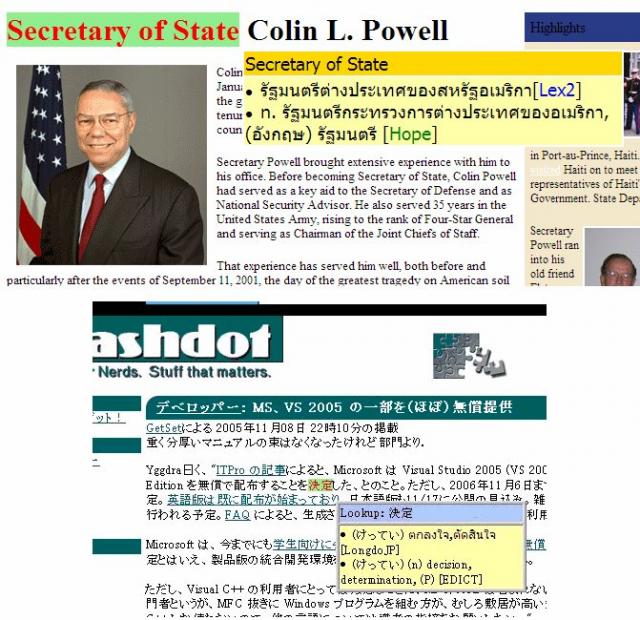
แสดงได้ทั้งความหมายของคำเดี่ยว และคำผสม ได้อย่างถูกต้อง
เช่น Secretary of State=รัฐมนตรีต่างประเทศของสหรัฐฯ (ในภาพตัวอย่าง),
High school=โรงเรียนมัธยมปลาย