You know the meaning of this word? click [add this word] to add this word to our database with its meaning, to impart your knowledge for the general benefit
ติดโพย (PopThai)
Move your mouse over the text to see pop-up windows.
(此れ) (pn) (1) (uk) (See 何れ・1,其れ・1,彼・あれ・1) this (indicating an item near the speaker, the action of the speaker, or the current topic); (2) (hum) this person (usu. indicating someone in one's in-group); (3) now; (4) (arch) here; (5) (arch) I (me); (6) (arch) certainly; (P) [EDICT]
(是) (pn) (1) (uk) (See 何れ・1,其れ・1,彼・あれ・1) this (indicating an item near the speaker, the action of the speaker, or the current topic); (2) (hum) this person (usu. indicating someone in one's in-group); (3) now; (4) (arch) here; (5) (arch) I (me); (6) (arch) certainly; (P) [EDICT]
(是れ) (pn) (1) (uk) (See 何れ・1,其れ・1,彼・あれ・1) this (indicating an item near the speaker, the action of the speaker, or the current topic); (2) (hum) this person (usu. indicating someone in one's in-group); (3) now; (4) (arch) here; (5) (arch) I (me); (6) (arch) certainly; (P) [EDICT]
(之) (pn) (1) (uk) (See 何れ・1,其れ・1,彼・あれ・1) this (indicating an item near the speaker, the action of the speaker, or the current topic); (2) (hum) this person (usu. indicating someone in one's in-group); (3) now; (4) (arch) here; (5) (arch) I (me); (6) (arch) certainly; (P) [EDICT]
(之れ) (pn) (1) (uk) (See 何れ・1,其れ・1,彼・あれ・1) this (indicating an item near the speaker, the action of the speaker, or the current topic); (2) (hum) this person (usu. indicating someone in one's in-group); (3) now; (4) (arch) here; (5) (arch) I (me); (6) (arch) certainly; (P) [EDICT]
(維) (pn) (1) (uk) (See 何れ・1,其れ・1,彼・あれ・1) this (indicating an item near the speaker, the action of the speaker, or the current topic); (2) (hum) this person (usu. indicating someone in one's in-group); (3) now; (4) (arch) here; (5) (arch) I (me); (6) (arch) certainly; (P) [EDICT]
(惟) (pn) (1) (uk) (See 何れ・1,其れ・1,彼・あれ・1) this (indicating an item near the speaker, the action of the speaker, or the current topic); (2) (hum) this person (usu. indicating someone in one's in-group); (3) now; (4) (arch) here; (5) (arch) I (me); (6) (arch) certainly; (P) [EDICT]
で
() (aux) (abbr) (arch) (See である) to be [EDICT]
() (n) (sl) detective [EDICT]
() (aux) (pol) (See だ・1) polite copula in Japanese; (P) [EDICT]
() (conj,int) (See それでは) then; well; so; well then; (P) [EDICT]
() (conj) (1) but; however; though; nevertheless; still; yet; even so; (prt) (2) even; (3) however; no matter how; even if; even though; (4) ... or something; (5) (as 〜でも〜でも) either ... or ...; neither ... nor ...; (pref) (6) (before an occupation, etc.) pseudo-; quack; in-name-only; (7) (before an occupation, etc.) (See でもしか) for lack of anything better to do; (P) [EDICT]
(出) (n,n-suf) (1) coming out; going out; outflow; efflux; rising (of the sun or moon); (2) attending (work); appearing (on stage); one's turn to go on; (3) start; beginning; (4) origins; background; person (or item) originating from ...; graduate of ...; native of ...; member of ... (lineage); (5) architectural member that projects outward; (6) highest point of the stern of a ship; (7) (uk) (usu. after the -masu stem of a verb as 〜出がある or 〜出がない, etc.) amount (comprising something); amount of time or effort required to do something; (P) [EDICT]
は
(葉) ใบไม้ [LongdoJP]
() (int) (1) (pol) yes; (2) OK (used to get attention prior to an utterance); okay; (3) giddy-up; giddap; (P) [EDICT]
(破) (n) (See 序破急) (in gagaku or noh) middle section of a song [EDICT]
(葉) (n) leaf; (P) [EDICT]
救う
(すくう) (v5u,vt) to rescue from; to help out of; to save; (P) [EDICT]
よう
() (exp) (volitional form of verb + ga) regardless of; whether (or not) [EDICT]
() (adj-pn) (See 様だ) like; similar to [EDICT]
() (exp) (1) in order to (e.g. meet goal); so that; take care (so as); (2) hoping or wishing for something; (P) [EDICT]
() (int) alright; all right; right on; looking good; OK; okay; (P) [EDICT]
(酔う) (v5u,vi) to get drunk; to become intoxicated; (P) [EDICT]
(様) (n-suf,n) (1) (uk) (See 様だ) (usu. after the -masu stem of a verb) appearing ...; looking ...; (2) (usu. after the -masu stem of a verb) way to ...; method of ...ing; (3) (usu. after a noun) form; style; design; (4) (usu. after a noun) like; similar to; (n) (5) thing (thought or spoken); (P) [EDICT]
(用) (n,n-suf) (1) task; business; (2) use; duty; service; (3) (See 用を足す) call of nature; excretion; (P) [EDICT]
(葉) (suf,ctr) (1) counter for leaves, pieces of paper, etc.; (2) (arch) counter for boats [EDICT]
() (exp) (1) (See ませんか) (used to ask a question in the negative) won't (hasn't, isn't, doesn't, etc.); (2) (used to make invitations, express desires or give indirect commands) won't you [EDICT]
() (conj,aux) (1) (See ない) without doing ...; (aux) (2) used in sentence-final position as an indirect prohibition [EDICT]
(内) (suf) inside; within [EDICT]
(亡い) (adj-i) (See 無い) dead [EDICT]
(無い) (adj-i) (1) (uk) (See 亡い) nonexistent; not being (there); (2) unpossessed; unowned; not had; (3) (See またとない) unique; (4) (as ...ことがない, etc.) indicates negation, inexperience, unnecessariness or impossibility; (aux-adj) (5) (See ない) (after the ren'youkei form of an adjective) not ...; (6) (after the -te form of a verb) to not be...; to have not ...; (P) [EDICT]
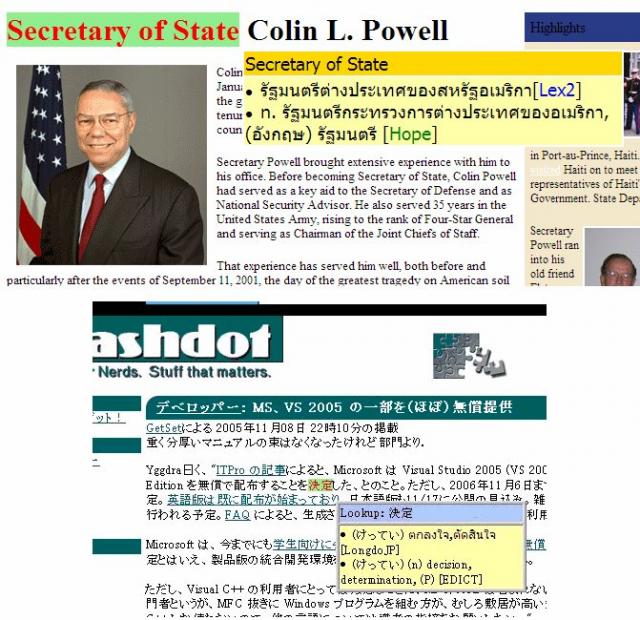
แสดงได้ทั้งความหมายของคำเดี่ยว และคำผสม ได้อย่างถูกต้อง
เช่น Secretary of State=รัฐมนตรีต่างประเทศของสหรัฐฯ (ในภาพตัวอย่าง),
High school=โรงเรียนมัธยมปลาย